How to Show Client Work Under NDA in Your Portfolio
How to include confidential client work in your portfolio without breaking NDAs — practical strategies for designers, developers, and creatives.
If you have been freelancing or working in-house for any length of time, you have probably hit this wall: your best work is locked behind a non-disclosure agreement, and your portfolio looks thinner for it.
This is one of the most common frustrations among experienced creatives, developers, and consultants. The longer your career, the more likely it is that your strongest projects are exactly the ones you cannot show. Enterprise UX work, internal tools, product redesigns for early-stage startups — these are rarely things clients want publicized.
The good news is that "under NDA" does not always mean "off-limits for your portfolio." There are real, legitimate strategies for including confidential work in ways that respect your agreements and still showcase your capabilities.
Start By Actually Reading Your NDA
This sounds obvious, but most people sign NDAs without fully understanding what they restrict. An NDA is not a blanket prohibition on ever mentioning a project exists.
Typical NDAs restrict:
- Sharing specific confidential business information (metrics, revenue, internal strategies)
- Disclosing proprietary technical details or source code
- Publishing materials that identify the client without their permission
Most NDAs do not restrict:
- Mentioning that you worked on a project in general terms
- Describing your role and the type of work involved
- Showing the final output if it was publicly released
If you are uncertain, contact the client and ask. You might be surprised — many clients are fine with you including the work as long as you run it by them first.
Ask for Permission (You Will Get It More Often Than You Think)
The easiest solution to the NDA problem is also the most overlooked: just ask.
Clients who were happy with your work are often willing to grant permission for portfolio inclusion, especially if you show them exactly what you plan to publish. Draft a brief email outlining what you would like to include — a short description of the project, your role, and two or three images or outcomes — and ask if they would approve it.
A surprising number of past clients say yes. The ones who say no typically do so because they are protective of specific details, not because they want to prevent you from having a career. Sometimes a simple adjustment — removing their company name, swapping in a mockup of the final design rather than production screenshots — is all it takes.
For clients you worked with recently, this is the highest-leverage move available to you. A five-minute email is worth sending before you write off an entire project.

Anonymize the Work
If the client declines full permission, anonymizing is the next best option. The goal is to remove identifying details while keeping everything that demonstrates your capabilities.
Practical ways to anonymize a project:
- Remove the company name and logo. Replace them with a placeholder or describe the client as "a series B fintech startup" or "a regional healthcare provider" — enough context to explain the problem without revealing who hired you.
- Redact or replace sensitive content. UI screenshots with internal dashboards can have actual data replaced with placeholder content. Written deliverables can have proprietary terminology swapped out.
- Alter visual branding. Swap out client brand colors and typography for a neutral palette. The layout, structure, and design thinking remain intact — the identifying skin does not.
- Composite multiple projects. If similar problems came up across multiple clients, you can create a composite case study that draws from several engagements without exposing any one client's work.
The line to stay on the right side of: do not present the work as something it is not. An anonymized case study should make clear that details have been changed to protect client confidentiality. That transparency is not weakness — it signals professionalism and experience with enterprise-level work.
Show the Process, Not Just the Output
Even when you cannot show the final product at all, you can almost always show your process.
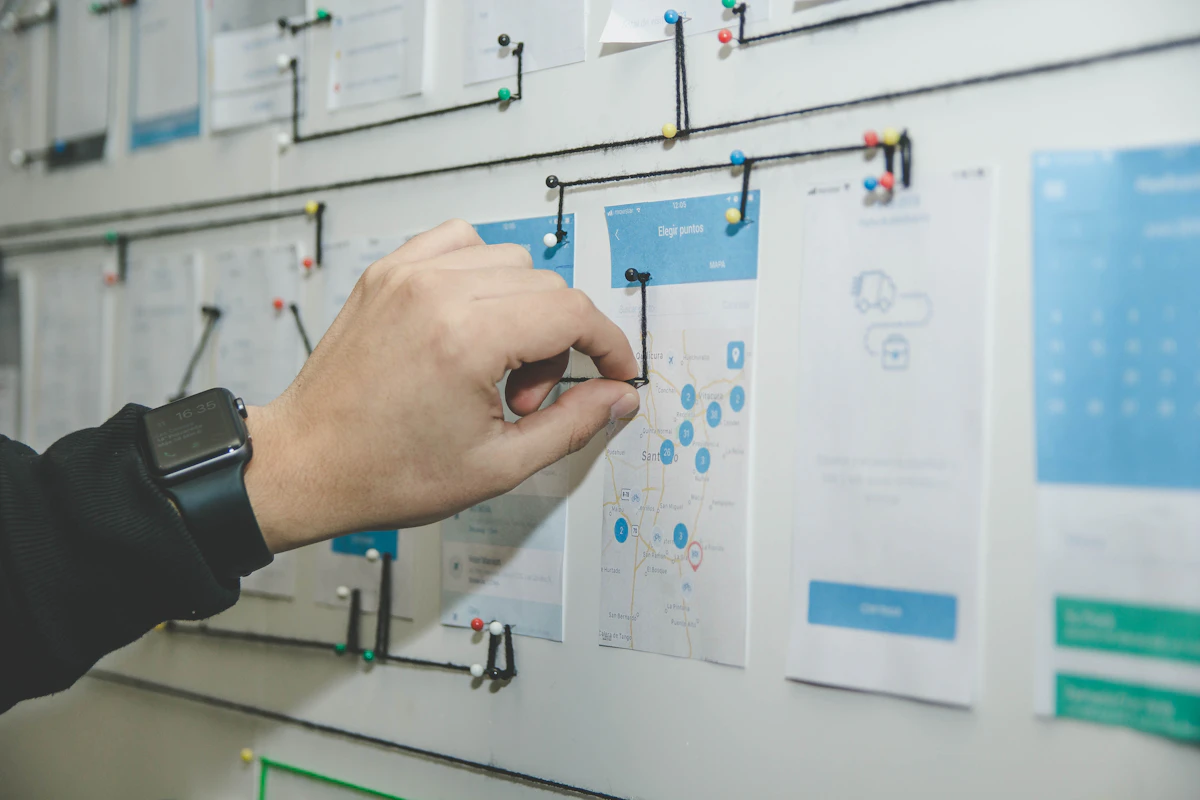
Sketches, wireframes, early explorations, and mid-project iterations rarely contain the confidential information that final deliverables do. A UX designer who cannot share a live product can still show user research frameworks, annotated wireframes, decision trees, and before/after interaction flows — none of which exposes anything proprietary about the client's business.
This approach often produces stronger portfolio entries than polished finals anyway. Process documentation answers the question clients are actually asking: what is it like to work with this person and how do they think? A screen of wireframes with thoughtful annotations communicates more about your judgment than a finished UI screenshot with no context.
Pair the process artifacts with a written description of the problem you were solving, the constraints you were working within, and the outcome you achieved — even if the outcome is described in general terms ("reduced the checkout drop-off rate significantly" rather than "by 34%").
For more on structuring this kind of documentation, the portfolio case study template covers the four-part format that works across disciplines.
Describe Outcomes Without Disclosing Numbers
Metrics are some of the most tightly restricted information under typical NDAs. Specific revenue figures, conversion rates, and growth percentages are often treated as highly confidential — and revealing them without permission can create real legal exposure.
You can reference outcomes without giving away the numbers:
- "The redesign measurably improved conversion on the primary acquisition flow"
- "The internal tool reduced the team's manual reporting time from hours to minutes"
- "The rebrand led to a significant increase in inbound inquiries within the first quarter after launch"
Vague by necessity, yes — but not useless. Describing the direction of impact ("significantly improved," "reduced friction," "increased engagement") is enough to establish that the work worked. If a potential client asks directly about specific metrics, you can tell them honestly that those details are under NDA, which often lands as more credible than a self-reported number anyway.
Create a Password-Protected Section
Some client work that you genuinely cannot publish widely may still be shareable in a more controlled context. A password-protected portfolio section lets you walk serious prospects through confidential projects during an active conversation — without broadcasting them to the open internet.
This approach is common among senior designers and consultants. You share the password only when you are already in a qualified conversation with a potential client. It is a reasonable middle ground between full public disclosure and hiding the work completely.
If a prospect asks to see more of your work before deciding whether to proceed, directing them to a password-protected section signals that you have depth beyond what is publicly visible, while still respecting the confidentiality of the projects involved.
Build Spec and Personal Projects to Fill Gaps
If large sections of your work history are locked behind NDAs, the most durable long-term fix is to build work you own outright. This includes:
- Spec work for companies or problems you find interesting — a redesign of a product you use daily, a brand identity for a fictional company in an industry you want to work in
- Personal projects — tools, sites, or visual work created on your own time with no client relationship
- Open-source contributions — code and design work with full public visibility by nature
Spec work is sometimes dismissed as a portfolio shortcut, but at Dribbble and Behance, some of the most-viewed portfolio pieces are self-initiated. What matters is the quality of the thinking and execution, not whether a client commissioned it.
Be transparent about what is spec work. Label it clearly. Potential clients are not expecting every portfolio piece to be client work — they are evaluating your capabilities, and a well-executed personal project demonstrates those just as well as a paid commission.

What to Say in the Project Description
When you include NDA work in your portfolio using any of the above strategies, the description matters. Be direct and brief about the constraints:
"This project is under NDA. Client details have been anonymized and specific metrics are not disclosed. The case study shows the design process, key decisions, and general outcomes."
One sentence is enough. Do not over-explain or apologize. Senior hiring managers and experienced clients have seen dozens of NDA disclaimers — they understand completely, and they appreciate the honesty.
What you should not do is skip the description entirely and let visitors wonder why your project entry looks sparse or oddly generic. A brief acknowledgment of the constraints, paired with rich process documentation, reads as more credible than a well-dressed case study that glosses over the gaps.
The NDA problem never goes away entirely — the longer your career, the more it comes up. But "I cannot show my best work" is not a permanent excuse; it is a problem with real, tested solutions.
For a full audit of what your portfolio should include beyond individual projects, the freelance portfolio mistakes guide covers the structural and strategic issues that cost freelancers clients regardless of how much client work they can or cannot show. If you are building your portfolio from scratch on mnml.page, the case study blocks are structured to accommodate exactly the kind of write-ups described here — process documentation, anonymized outcomes, and password-protected sections for your most sensitive work.
Tools & Resources
-
Behance — Adobe's portfolio platform used by millions of creative professionals. Browse top-featured work in your discipline to see how experienced practitioners handle project documentation — many include detailed process work that does not expose any client-confidential information.
-
Dribbble — Primary visual portfolio platform for designers. A useful reference for how spec and personal work is presented alongside client work — and evidence that self-initiated projects can outperform commissioned ones in terms of engagement and visibility.
-
Smashing Magazine — Building a Portfolio of Design Process — Practical guide to building a portfolio that documents thinking, not just output. Especially useful for anyone whose client work is mostly hidden and who needs to make process artifacts carry more weight.
-
Creative Bloq — How to Deal with NDA Portfolio Work — Covers the practical and legal side of sharing restricted work, including how to approach clients about portfolio permissions and what anonymization actually looks like in practice.
-
mnml.page for Designers — Minimal portfolio builder built for freelancers and creatives. Supports case study layouts, password-protected sections, and a block structure that makes process documentation straightforward to build without touching code.
Ready to build your site?
Create a beautiful portfolio or personal website in minutes. No code, no complexity.
Get started